Thursday, July 29, 2010

Van Gogh on the Blazing, Majestic, Eternal Love of God


In my last post, I very briefly mentioned that in the book 'The Divine Commodity', I learned that van Gogh used the color yellow to represent Divine Love. After learning a little more than the ear incident about Van Gogh, I will definitely never look at his paintings the same way again. 'Starry Night' was always one of my favorites of his, but now I appreciate it even more. He was one who saw the Divine in nature and tried to convey it though his paintings.

One cannot do better than hold onto the thought of God through everything, under all circumstances, at all places, at all times, and try to acquire more knowledge about Him, which one can do from the Bible as well as from all other things. It is good to continue believing that everything is more miraculous than one can comprehend, for this is truth; it is good to remain sensitive and humble and tender of heart . . . . For what can one learn that is better than what God has given by nature to every human soul -- which is living and loving, hoping, and believing, in the depth of every soul, unless it is wantonly destroyed?
-- Vincent van Gogh

Friday, July 23, 2010

A Dream, A Book, A Thought


Several nights ago I had a very vivid dream. One of those dreams where I can still recall much of the details. In this dream I was at a church. This church was a one stop 'shopping' destination, where there were rows of goods and all the goods were uniform in color - blue and gold. There was also a restaurant, a laundry facility, and a large stage at the front. Many of the members lined the asles and were 'ministering' by happily demonstrating the church's products. At the front there was an elaborate performance going on, and the performers were being treated like royalty. It was a very bizarre scene. Each performer had several people surrounding them; one person holding a microphone, one person holding a camera, and one person standing behind them with water and a towel. This church was a very busy place but there was no mention of the Father, no mention of his beloved Son Jesus, and no mention of the Spirit. Nor any was there any mention of the astounding news of our adoption. Only this frenzy of activity centered around goods, services, and entertainment.
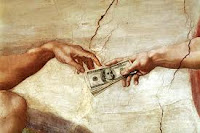
What does such a dream mean? I'm not sure about all the details; for example why were all the products blue and gold? I have no idea. However, I would say that in general it means that in an effort to be relevant to our culture, we have lost the heart of our faith. The dark side of Consumerism in our culture is apparent if you think about it for a minute. Owning particular name brands have become a way to identify or fit in with a particular group. (Think Apple, or Mercedes Benz, or Abercrombie) Often it's all about style over substance, and we buy into the idea of constructing an identity by consuming certain brands. Christian Products? Christian Entertainment? Christian Services? Has Christianity become a brand that you use or wear, rather than a deep relationship purchased by Christ that we walk in day by day?

A while back I did read a book called 'The Divine Commodity' by Skye Jethani. In the book he takes an interesting approach, using some of the works of Vincent Van Gogh as a launching pad to critique both consumerism, and consumer Christianity. A prominent theme in this book, that runs as a counter point to the shallowness of consumerism, is the the relational nature of God and man, and the power of God's Divine Love; Van Gogh would use the color yellow to represent Divine Love, and the sky in many of his paintings would be ablaze with this Divine Love. Sadly our ability to connect to God, and one another has atrophied in this culture. Jethani writes:
In his book Following Christ in a Consumer Culture, John Kavanaugh argues that our lifestyle of guarded isolation is the result of grounding our identities in external possessions. Consumerism has caused our attention to be fixated on the surface and style of our lives so that over time we have lost the ability to nourish our interior life. Kavanaugh says that without a meaninful interior life, a definable sense of self apart from possessions, we also lose the skills necessary to establish meaningful relationships.

The book is a fairly short read, and is definitely worth re-reading so that you can let the message sink in. I definitely recommend it.

The night before I had the dream, I was actually pondering Acts 21 and since we are on the subject of Syncretism, I figured I would share my thoughts about this as well. The details of Pauls arrest might be a bit surprising to those who have entered the fray of the 'Culture Wars'. There is some irony there calling it 'Culture Wars', when consumerism has invaded the church.... but i digress... Anyway, back to Pauls arrest. Do you know the details of what he was doing when he got arrested? Was he stirring up a crowd? Preaching on a street corner? No, in fact he says, "My accusers did not find me arguing with anyone at the temple, or stirring up a crowd in the synagogues or anywhere else in the city." (Acts 24:12). In fact, he was trying to show that he was still a Jew (who happened to believe the Messiah had come). He was participating (and paying for) a cleansing ritual at the temple as a way to identify with his fellow Jews. He was being conciliatory, but they would have none of that. It's actually quite a different picture than the typical American Christian activist isn't it? My thought? Maybe we fuse some of our American ideals, with our faith. And we don't give it a second thought because America is a Christian Nation right?? Yeah... right...

Friday, May 07, 2010

Not of this World


Jesus answered, "My kingdom doesn't belong to this world. If it did, my followers would have fought to keep me from being handed over to the Jewish leaders. No, my kingdom doesn't belong to this world." John 18:36 (CEV)


Last night I watched 2 programs on the History Channel that happened to give some interesting insight into how a 1st century Greek (Gentile) would understand the New Testament. The first program was on Hades, the god of the dead in Greek mythology. He was the god that all Greeks feared, and almost none worshiped. They believed that no one could escape Hades' eventual grip. So for them to read in Revelation that Death and Hades' are cast into the lake of fire, would mean much more than just a place; it would read like a great hope -- the end of Hades' grip on any persons life.

The second program was on Alexander the Great's attempt to conquer India. As I was sitting there trying to get my head around why anyone would travel thousands of kilometers and fight numerous tribes in order to lay claim to some distant territory, the words of Jesus in John 18:36 came to mind. He contrasts the world's idea of a kingdom, with God's. The worldly kingdoms use armies, force, and violence to expand the territory of the King. In The Message, Eugene Peterson, phrases the last half of John 18:36 this way, "But I'm not that kind of king, not the world's kind of king." Jesus is a different kind of Lord altogether. He gives, rather than takes. He lays down his life for those in his Kingdom. He is one who uses the left handed indirect power of Love, rather than using the sword. He doesn't ask his subjects to fight, but rather live as he lived. He neither coerces people to be subject to him by fear, nor begs for subjects. He only asks us to believe that he IS the resurrected, glorious Lord. He is better than good; better than we could imagine; and worth following.

Wednesday, May 05, 2010

I am so here right now...


"... a quiet hush imprints itself upon my occasionally frenetic thoughts; momentum is lost in that haze, and all attempts at forging new thoughts, new paths, new articulations—fall flat and silent long before their time.
Is this what it is to be content? Lost in the doldrums of ceaseless being? Where is the doing? The fear-induced striving has been slowly stripped from my heart."
-- ML, The Doldrums


The Doldrums beautifully expresses where I seem to be at right now. It's not a place of sadness nor is it a place full of energy and thought. For now my thoughts tend to gravitate to a singular subject, and the words to adequately express my thoughts fail me. I do feel a small restlessness -- echos from a past life of striving but, like Moses, I refuse to move on from here unless Father goes with me. So I am content to stay here until I feel his nudging.


"Even less can I deny the beauty of His love that unmasked those things; how it pervades my very being with ruthless and shocking mercy. How tender the heart of love that pours itself upon my wounds—mostly self-inflicted—and heals like a salve; it is the only true panacea, the one thing that makes the term plausible. Yet here I am in the doldrums. How long oh Lord, how long?"
-- ML

Monday, April 26, 2010

Coffee....


I like coffee. OK, so I like cheap Coffee too. Sorry to all you coffee snobs out there, but it probably has something to do with my introduction to coffee.

You see, when I was in elementary school (in the days when we were living in San Antonio) there was this bus that came around every Sunday and took kids to church. This church was small, it didn't have Sunday School and it didn't have great programs. What it did have was a bus, and some nice older folks who thought they needed more kids around that church. So they would go to some of the local neighborhoods and pick up kids. Of course this was back in the days when churches were generally considered trustworthy and parents didn't think twice about putting their kids on a church bus. This church didn't disappoint either, the only crime they could be accused of is letting at least one kid have coffee.

I don't remember much about the worship services there. I know they sang, some guy talked for way too long, then they passed around a plate of juice and crackers which I was forbidden to partake of. But, before the service began, all the adults would stand around and talk while drinking cheap coffee made in an old fashioned peculator and eating a doughnut. So I decided that I should do the same thing. I got a doughnut (of course) and some coffee; which I first tried black but, being a kid, that was too much for me. So I added some sugar and creamer and that made it taste good to me. For whatever reason, these older (probably retired) adults didn't chase me away from the coffee. In fact they were very kind, and would chat with me just like they did with the other adults. In many ways they reminded me of my grandma, who also was kind to me.

Because of that church and their kindness, coffee and doughnuts became holy to me. They were like the bread and wine to me. Coffee is a sacred reminder to me; it is the thing I drink when I'm tired, or when I doubt. Since then, I've had great Italian coffee in the heart of Rome, and I've had barely drinkable coffee made over a campfire. But it is always a sacred thing to me, a reminder of the kindness of God shown through a few kind believers.

Thursday, January 21, 2010

Book: Introvert Power


Introverts are often misunderstood; even by other introverts. As Laurie Helgo, PhD, points out in her book Introvert Power: Why Your Inner Life Is Your Hidden Strength, if you live in America, then you live in an extroverted society and introversion can often be looked at by society as a problem or short coming. If we turn down an invitation to a big party, people will often wonder 'What's wrong?' Or if we say we need to be alone for a while, everyone worries. It's also quite common for introverts to think about their answer before they throw it out there, and this sometimes earns us a false impression of being 'slow'. Dr. Helgoe is a Psychologist and fellow introvert, who has written a great book that will help dispel some of these misunderstandings, and encourage introverts to be comfortable with their introversion.

In Psychology, Introversion and Extroversion are defined as preferences, not conditions or traits. Dr. Helgo describes the Introvert preference this way: "Introverts generally prefer a rich inner life to an expansive social life; we would rather talk intimately with a close friend than share stories with a group; and we prefer to develop our ideas internally rather than interactively." (p. 4) Introverts also prefer sharing ideas, over small talk. And we recharge our batteries through quiet solitary activities such as book reading, walks, meditation, movies, or intimate conversation with plenty of time to pause and reflect. While big groups, and loud parties tend to exhaust us. An extrovert, by contrast, is energized by big parties, large groups of friends, and spirited fast paced conversations with topics running all over the map.

In a previous post I said that I would love to be an extrovert but after reading this book, I'm quite happy and content to stay the way that I am. I really do enjoy my introversion preference and will quit worrying that I'm missing out on something just because I don't enjoy a big get-together. Instead I'll focus on what I do enjoy -- family, smaller groups with just a few friends, books, and solitude.

Dr. Helgo's book is meant to educate both introverts and extroverts alike, and there is much more to the book than I've mentioned here. She wants everyone to know that being an introvert isn't a handicap; we aren't slow, we aren't snobs, we aren't unsocial or anti-social. We just process differently, and introverts have many strengths that we can bring to society. So be sure to give it a read if you want to get some ideas on how to carve out some needed quite space in your life, or if you want to understand the introvert in your life.

Click to view my Personality Profile page

Thursday, January 07, 2010

Hypocrisy and Acceptance in a Culture stripped of Grace

Last night a good friend of mine, who is a Christian apologist, mentioned that one of the most common questions she is asked is the question of hypocrisy in the Church. Her typical answer to this question is to remind the questioner that the Church is made up of people, and people will fail. While this is certainly true, the fact that this answer is used and accepted points to something deeper in our culture; that is, we live in a culture stripped of Grace.
How many times have you heard of a coach that has gotten his team to the playoffs, but when the team loses the playoff game it seems that everyone is calling for his resignation. Or how about when a good pitcher has a bad day? For our culture, failure is not an option, and it seems that moral failure is equated with hypocrisy. This is of course a departure from the original meaning of hypocrisy.
Hypocrisy by definition means that we would pretend to believe something that we don't actually believe, or to hide our true self behind a false exterior. And I believe that since we live in a culture stripped of Grace, this has become the norm for many; and maybe that is why we don't label it hypocrisy any more. We all tend to hide traits, values, or preferences that a particular group may find unacceptable. When in a church setting we may try to hide an addiction, or anger, or doubt. And in a group of our peers at work or at school, we may hide something as simple as still liking Disney movies, we may hide our feelings, or we may even go against our conscience. We do this because there is a deep longing for acceptance that we can't deny and, in a culture stripped of Grace, the last thing you would want to do is to admit your flaws. Oh we have our moments when the facade falls apart and everyone gets to have a moment of honesty, but then we are expected to get it together and move on.
I think the thing that drives hypocrisy, or hiding is the graceless culture we live in. I must admit that it's one thing to recognize that we live in a graceless culture, and it's quite another thing to practice grace. It's a struggle for me, a coping mechanism I learned early on was to not give second chances to people who hurt me. It will probably take a lifetime to unlearn that, but it is definitely something I will strive to do.